Support Your Horse's Comfort, Movement, & Wellbeing

Explore Light Therapy for Horses

Discover educational resources and light therapy options for the horses in your care. Explore practical applications, learn about available devices, and find guidance to help you choose an approach that fits your goals. 

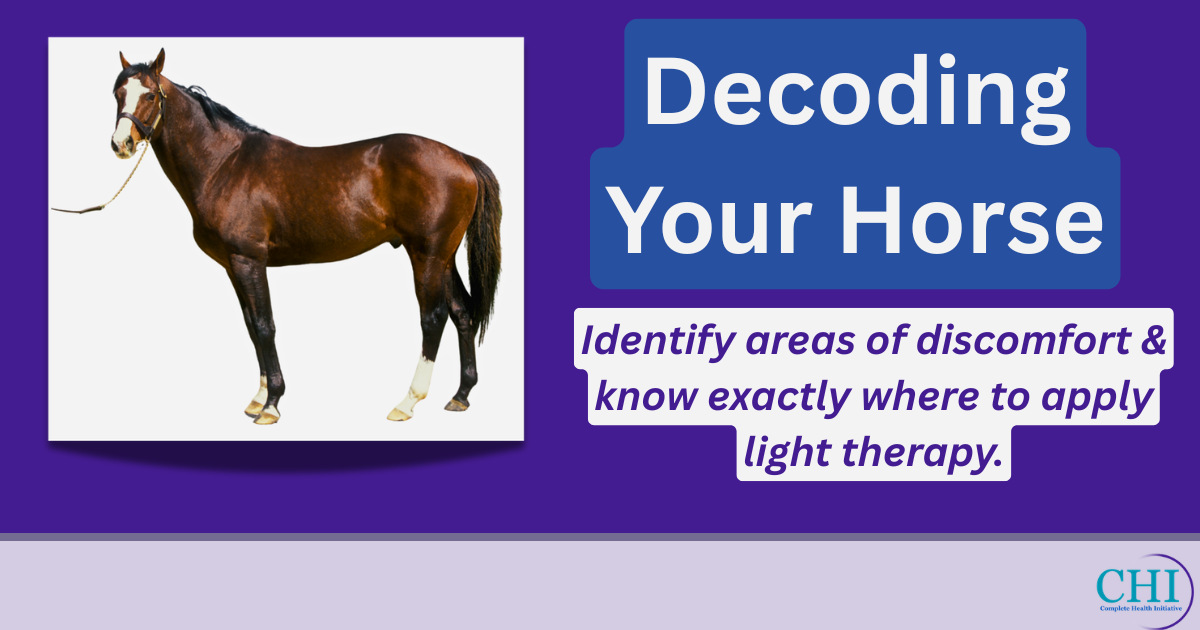
"Decoding Your Horse"
Can You Read Your Horse?

Your horse is constantly communicating through posture, movement, behavior, and subtle changes in how they stand and move.

Decoding Your Horse teaches you to slow down, observe, and develop a deeper awareness of what your horse may be communicating—before you apply light.

Through guided observation and hands-on learning, you'll explore how to recognize patterns, notice areas that may warrant attention, and incorporate light therapy into a thoughtful approach to equine well-being.

Write your awesome label here.
Learn to observe. Learn to listen. Learn to understand.

How Does Light Therapy Work for My Horse?

Write your awesome label here.

Beneath the Surface

Light therapy uses specific wavelengths of light to deliver signals that interact with the body's cells.

In photobiomodulation (PBM), light can influence cellular processes involved in energy production and cell signaling. Researchers also study how light interacts with nitric oxide, a molecule involved in vascular signaling and blood flow.

The science of photobiomodulation continues to evolve. Researchers are exploring how wavelength, dose, and application methods influence biological responses.Understanding the science beneath the surface can help you make more informed decisions about light therapy and your horse's wellness routine.

Understanding what happens beneath the surface can help you make more informed decisions about how light therapy may fit into your horse's wellness routine.

He Shows No Lameness! Hank's Story:

On April 24, 2024, an F3 tornado moved through Hank’s pasture, causing extensive damage and scattering debris throughout the area.

Hank sustained multiple injuries during the storm, including a deep puncture wound to his back that extended into his abdominal cavity.

Reflecting on Hank’s recovery, his owner, Berg, described his condition this way:

“Other than some scars, he shows no lameness. He canters around like nothing happened.”

How Was Light Incorporated Into His Care?

During Hank’s recovery, light therapy was incorporated into his care using applications that included:

  • Vitality points
  • Hips and lower back
  • Selected acupuncture points

Hank’s story illustrates one way light therapy was incorporated into his recovery and ongoing care. Every horse and injury is different, and veterinary assessment and appropriate medical care remain essential.


Featured Horse Products
Pod & Wrap

Write your awesome label here.

Targeted Photopuncture with the Light Pod

The Oral IQ Light Pod delivers focused red and near-infrared light for targeted photobiomodulation (PBM) applications.

Photopuncture applies light to selected acupuncture points, bringing together traditional point-based approaches and the science of light therapy.

Light application to an individual point may take as little as 15–30 seconds, depending on the application, device settings, and protocol.

The Pod can be held by hand for targeted applications or positioned on the horse when appropriate and in accordance with the manufacturer's instructions. Its compact design makes it a versatile option for working with individual points and smaller areas.
Write your awesome label here.

Broad-Area Light Therapy with the Wrap

The Oral IQ Light Wrap provides a larger light-application area for working with broader regions of the body.

Its flexible design conforms to areas such as legs, joints, and larger muscle groups, delivering red and near-infrared light across the selected area.

Sessions are typically around 20 minutes, depending on the application, device settings, and light therapy protocol.

The Wrap offers a hands-free option for broader-area applications, while the Light Pod is designed for more targeted work with individual points and smaller areas.

How it Works

Light Therapy & Your Horse's Biology

Light Therapy, also known as Photobiomodulation (PBM), uses specific wavelengths of light to interact with cells and tissues.

When light photons enter the body, they can be absorbed by cellular structures, including components of the mitochondria. This interaction can influence cellular signaling and energy production and initiate a cascade of physiological responses.

What Happens Beneath the Surface?

1. Cellular Energy

Photobiomodulation can influence mitochondrial activity and the production of Adenosine Triphosphate (ATP), the primary energy currency used by cells. Cellular energy is fundamental to the many processes required for normal cellular function.

2. Circulation

PBM can influence vascular activity and circulation in the area receiving light. Increased local blood flow can support the delivery of oxygen and nutrients to tissues and the removal of metabolic byproducts.

3. Inflammatory Response

Photobiomodulation influences cellular processes associated with the body's inflammatory response. This is one reason PBM has been extensively studied in relation to inflammation, tissue response, and recovery.

4. Pain

PBM has been studied for its effects on pain and the physiological processes associated with pain. Its effects on circulation, cellular signaling, and inflammatory response can all be relevant when light therapy is incorporated into a horse's care.

5. Acupuncture Point Applications


Light can also be applied to specific acupuncture points. Photopuncture combines the principles of acupuncture point application with light therapy, providing a non-invasive way to stimulate selected points with light.

In Simple Terms

Light provides a signal that interacts with the body's cells and tissues. The wavelength, power, dose, timing, and application all influence how that signal is delivered.

Understanding these principles helps explain why different light therapy systems and applications can be used in different ways.
Write your awesome label here.

The Quality of Your Light Matters
Equine Light Therapy Devices

When it comes to light therapy, the device you use matters.

CHI offers professional-quality light therapy systems selected for their specifications, versatility, construction, and application capabilities. Understanding the differences between devices—including wavelength, power density, pulsing, treatment area, and application method—helps you choose the right tool for your horse.

From targeted photopuncture with the Oral IQ Light Pod to broader-area applications with the Oral IQ Light Wrap, each device offers different capabilities for different needs.

Explore the specifications below to find the system that fits your needs.

TESTIMONIALS / CUSTOMER REVIEWS

We first started Light Therapy to help our young stallion with sperm counts. Though we were unable to get counts, we’re pretty sure it helped, especially with libido. We use it on other horses with sore muscles and such with great results. In February, we had a yearling get hurt. He ran a 2 inch pipe into his chest. Vet told use to wait tell drainage stopped then start the red light.

Thank you so much for introducing us to red light!!!

Broken Z Ranch
Clark, Robin, and Niome Zeisneiss Nevada, Iowa

Our pony was showing symptoms of colic. We called 3 different veterinarians. No one could come out. We were able to use Photopuncture and get her past the colic. So grateful for our Lights!

~ Sue Musich
Our Rocky Mountain mare has a history of laminitis. When she has flare ups, we use Photopuncture and Light Therapy Wraps to help with the inflammation and pain. We always have our Lights on us when we're in the stable. We use it on all our horses (and ourselves).

~ Kelly Patrick
I've found that integrating Photopuncture and Light Therapy into my equine massage business has delivered exceptional results for my clients' horses. They are not only experiencing tangible benefits, but the horses also become noticeably more relaxed and comfortable after a session.

~ Andrea Postolka 
Postolka Equine Therapeutics

COMMON USES

Light Therapy and Photopuncture can be incorporated into a variety of equine wellness and care applications. Photobiomodulation is being studied for its interactions with cellular processes involved in circulation, inflammatory responses, and pain.

Applications vary depending on the horse, the area being addressed, and the light therapy system and protocol used.

Explore some of the areas where light therapy may be incorporated into an equine wellness routine.

Write your awesome label here.

Meet Your Guide

I'm Diana Connolly, founder of Complete Health Initiative and a Certified Light Therapy Instructor with more than a decade of experience educating people about Photobiomodulation (PBM) and its applications for both people and animals.

My journey with light therapy began with an injured horse and an experience that sparked a deeper exploration into the science and possibilities of Photobiomodulation. That experience ultimately led me to build Complete Health Initiative around light therapy education, professional training, and practical applications for people and animals.

Through CHI, I also teach horse owners how to slow down, observe, and better understand their horses through Decoding Your Horse.

What Can Light Therapy Do?

PBM has been studied for its effects on cellular energy, circulation, inflammatory response, pain, and other physiological processes. Light can also be applied to specific acupuncture points as part of photopuncture.

My goal is to help horse owners understand how light therapy works, why wavelength and application matter, and how to use light thoughtfully as part of their horse's care and wellness routine.
Write your awesome label here.

Studies & Research

Photobiomodulation (PBM) has been studied in both human and animal research, including investigations into wound healing, inflammatory responses, tissue recovery, and the biological mechanisms of light therapy.

The selected studies below offer a starting point for exploring the science behind PBM. Research findings vary by application, wavelength, dose, and study design, so results should be considered within their specific context.

Explore the Research

Low Level Laser Therapy in Horses:

A clinical report examining low-level laser therapy in 19 horses, primarily involving tendon or ligament inflammation.


Photobiomodulation improves cutaneous wound healing in an animal model of type II diabetes:

Research investigating how specific red-light parameters affected skin wound healing in a diabetic animal model.


Low-level laser (light) therapy (LLLT) in skin: stimulating, healing, restoring:

A review exploring the biological effects of low-level light therapy in skin, including its applications in tissue response and healing.


Mechanisms and applications of the anti-inflammatory effects of Photobiomodulation:

A review of the biological mechanisms of photobiomodulation and research investigating its effects on inflammatory processes across a range of experimental and clinical contexts.
Created with