Support Your Horse's Comfort, Movement, & Wellbeing
Explore Light Therapy for Horses
"Decoding Your Horse"
Can You Read Your Horse?
Take Your Learning Further
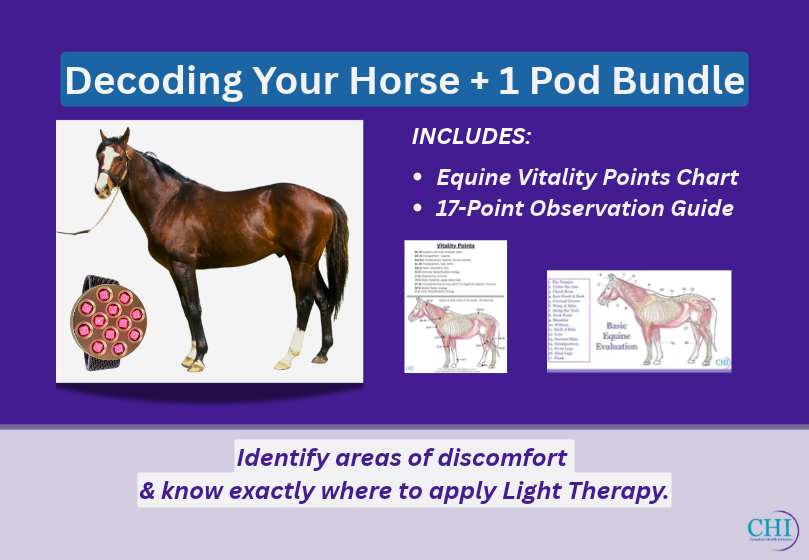
Decoding Your Horse + 1 Pod
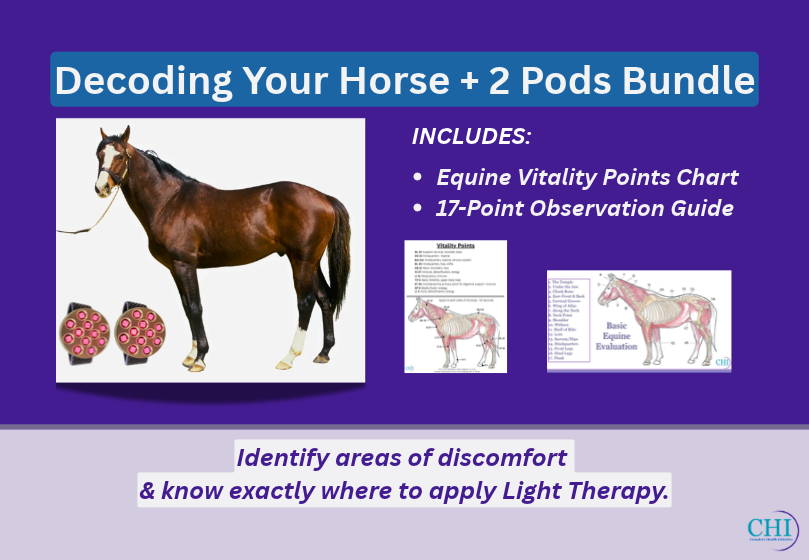
Decoding Your Horse + 2 Pods
How Does Light Therapy Work for My Horse?
He Shows No Lameness! Hank's Story:
On April 24, 2024, an F3 tornado moved through Hank’s pasture, causing extensive damage and scattering debris throughout the area.
Hank sustained multiple injuries during the storm, including a deep puncture wound to his back that extended into his abdominal cavity.
Reflecting on Hank’s recovery, his owner, Berg, described his condition this way:
“Other than some scars, he shows no lameness. He canters around like nothing happened.”
How Was Light Incorporated Into His Care?
During Hank’s recovery, light therapy was incorporated into his care using applications that included:
- Vitality points
- Hips and lower back
- Selected acupuncture points
Targeted Photopuncture with the Light Pod
Photopuncture applies light to selected acupuncture points, bringing together traditional point-based approaches and the science of light therapy.
Depending on the application and protocol, light may be applied to an individual point in as little as 15–30 seconds.
The compact Pod can be held by hand or positioned on the horse when appropriate and in accordance with the manufacturer's instructions. It's designed for individual points and smaller areas.
Broad-Area Light Therapy with the Wrap
How Light Interacts with Your Horse's Biology
When light photons enter the body, they can be absorbed by cellular structures, including components within the mitochondria. These interactions can influence cellular energy production and signaling pathways involved in a range of biological responses.
What Happens Beneath the Surface?
1. Cellular Energy: Light can interact with components of the mitochondria and influence processes involved in producing adenosine triphosphate (ATP), the energy source cells use to carry out their functions.
2. Circulation: Photobiomodulation has been studied for its effects on vascular signaling and local circulation. These processes are involved in the movement of oxygen and nutrients to tissues and the removal of metabolic byproducts.
3. Inflammatory Response: PBM can influence cellular pathways associated with the body's inflammatory response. Researchers continue to investigate these interactions and their relevance to tissue health and recovery.
4. Pain: Photobiomodulation has been studied in relation to pain and the biological processes associated with it. Research explores how cellular signaling, circulation, and inflammatory pathways may contribute to its effects.
5. Acupuncture Point Applications: Light can also be applied to selected acupuncture points. Photopuncture combines traditional acupuncture point concepts with light application, offering a non-invasive approach to stimulating selected points.
In Simple Terms
Light provides a signal that interacts with the body's cells and tissues. Wavelength, power, dose, timing, and application all influence how that signal is delivered.
Understanding these principles helps explain why different light therapy systems and applications can be used in different ways.
The Quality of Your Light Matters
Equine Light Therapy Devices
CHI offers professional-quality light therapy systems selected for their specifications, versatility, construction, and application capabilities.
Different devices offer different features, including wavelength combinations, power density, pulsing, treatment area, and application methods. Understanding these differences can help you make a more informed choice for your horse.
Explore the devices below to compare their capabilities and find the system that best fits your needs.
COMMON USES
Light Therapy and Photopuncture can be incorporated into a variety of equine wellness and care applications. Photobiomodulation is being studied for its interactions with cellular processes involved in circulation, inflammatory responses, and pain.
Applications vary depending on the horse, the area being addressed, and the light therapy system and protocol used.
Explore some of the areas where light therapy may be incorporated into an equine wellness routine.
Meet Your Guide
Studies & Research
Photobiomodulation (PBM) has been studied in both human and animal research, including investigations into wound healing, inflammatory responses, tissue recovery, and the biological mechanisms of light therapy.
The selected studies below offer a starting point for exploring the science behind PBM. Research findings vary by application, wavelength, dose, and study design, so results should be considered within their specific context.